Posts

Showing posts with the label Wikipedia

Wikipedia Trail: From Suvannamaccha to Phra Aphai Mani
Image
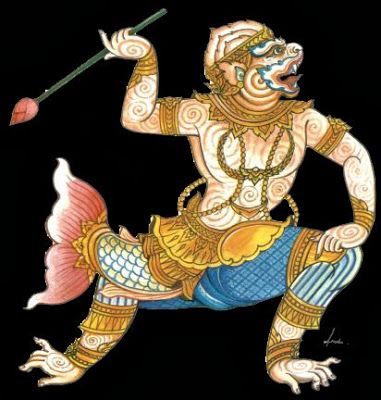
Suvannamaccha I started here because I am working on a story for my project dealing with Suvannamaccha and Hanuman, who became an item during the bridge construction in the Ramayana according to Thai folklore. Mermaids and Suvannamaccha in particular are strongly associated with luck in Thai culture, and banners of her can be found in many public places in older towns. Macchanu Macchanu is the son Suvannamaccha had without Hanuman's knowledge. Many years after their dalliance, Hanuman and Macchanu are fighting on opposite sides of a battle and see and recognize each other even without having met. Macchanu is described as a half-fish, half-monkey with serious battle skills. Here's an image of what he supposedly looks like. Macchanu Image Source: Detechter Matchanu-class Submarine The Thai Navy actually used Matchanu (an alternative form of Macchanu) as the name for a submarine, and there were a whole category of mythical-name vessels used way back in the late ...

Wikipedia Trail: From Krishna to the Historicity of Jesus

Image
Krishna I used Epified - The Krishna Story this week for my reading assignment, and was rather surprised to note some of the similarities between Krishna's birth and childhood and that of the story of Jesus. This prompted me to do a little digging to figure out who today worships Krishna, and what the differences were between the two men. Vaishnavism As Krishna is the avatar of Vishnu, those who worship him are referred to as Vaishnavas, and believe in numerous human incarnations, including Rama, Govinda, and Jagannath alongside Krishna. The parallels in Krishna's life to that of the biblical story of Jesus brought me to Kersey Graves' book, The World's Sixteen Crucified Saviors, boasting of no less than 346 parallels between the life of Jesus and Krishna. The World's Sixteen Crucified Saviors Messiah-types from Egypt, India, Nepal, Syria, Persia, and Rome are just a few of the locations. The biggest takeaway from this book (without reading it, mind you) is t...

Wikipedia Trail: From Nila to South Asian River Dolphins

Image
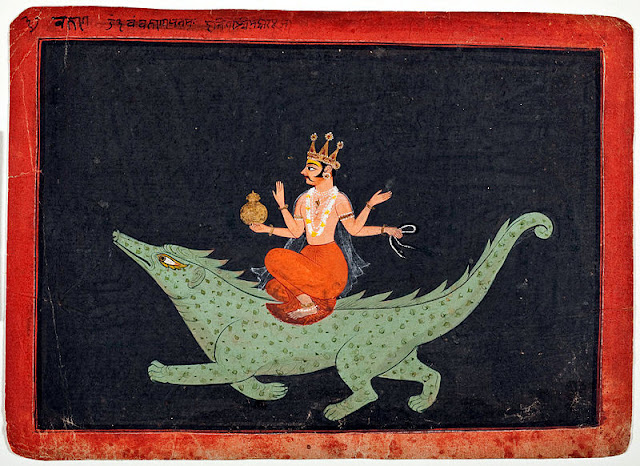
I knew I needed to do a little research on some of the characters featured in my storybook for Rama's Bridge, and I decided to look a little harder at the Vanara brothers this week. Nila, the brother of Nala, was my starting point. Nila  (Ramayana) Both of the brothers have some amazing credentials, but Nila is no less than the commander-in-chief of the Vanara army, while Nala is the architect of the bridge. Sources vary explaining precisely who built the bridge and who carried the rocks for it, but Nila has a rich military history and is regarded as a legendary general, as well as the son of Agni, the fire-god. Both of the brothers apparently have the ability to make stones float on water, which is related to Rama by Varuna during the Ramayana pre-bridge effort. Varuna While the sea-god Varuna has a brief mention in the Ramayana, he is one of the oldest known deities associated with Hinduism, and he is also associated with Buddhism and Jainism.  Rama conducts a three-da...

Wikipedia Trail: King Sagara to Shambhala

Image
I began this trail while looking up more information on King Sagara , mentioned in the "Bhagiratha and Ganga" story in the PDE Ramayana. He was said to have lost 60,000 sons and I wrote my story this week on that. While reading about him, I was interested to learn more about the age he lived in, because the scale of time involved in the story is massive. That led me to the Satya Yuga , the first of four Yugas (great ages) which cycle through endlessly. They are not the same length, and the Satya Yuga is 1,728,000 years long. This was fascinating because I already learned about the Kali Yuga, the final and darkest age which concludes with the arrival of.... Dasavatar: The Avatars of Vishnu Image Source: Wikimedia Commons Kalki , the final avatar that Vishnu occupies in the cycle of existence. He arrives to end the dark age of Kali Yuga, and he is mentioned not only in Puranic texts but also Buddhist literature. A text from Tibetan-Buddhism mentions that there are a...